Monday, February 12, 2018

Charles Manson & the Manson Family Murders


        Charles Manson is a name you may have recently heard, as he died only in November of last year.  Manson became prominent in the 1960s, as the leader of the "Manson family" cult that was responsible for killing pregnant actress Sharon Tate and several others. As a result of his crimes, Manson was sentenced to death in 1971 but was then sentenced to life in prison. The Manson Family was a "commune" that was established in the 1960s, as Manson became a "guru" in San Francisco's Haight Ashbury during the 1967 "Summer of Love" and the emergence of the counterculture movement. A said "scientologist", Manson recruited mainly women into his group, and taught them ideologies which implied that he was Christ, and that "they were the reincarnation of the original Christians". The group numbers varied at different times, yet many of them supported and enjoyed the "Manson Family" lifestyle which included frequent LSD and mushroom use. In 1968, the Family moved to an unoccupied ranch- where the beginning of Manson's "Helter Skelter" fanaticism began.

          In the late 1960s, when the Beatles "White Album" was released, Manson became obsessed with the boy band. Indeed, when talking to the rest of his family members, he emphasized that the Beatles were the "soul", and that "he could surpass the group in fame". In terms of what "Helter Skelter" is, it was originally a Beatles song, but Manson interpreted the term as "an apocalyptic war arising from racial tensions between blacks and whites."Although Manson's exact interpretations of the Beatles lyrics are extensive, he basically twisted up their meanings so that he entwined both religion and psychedelics in a highly misinterpreted way. He told the Family that the blacks would rise up and rebel against whites- a prediction he stated that he had made, but the Beatles had as well. Awkwardly and insanely enough, Manson also claimed that the Beatles "White Album" was a code for the Manson Family to follow to "preserve the worthy" from the upcoming "race war". After moving from the desert ranch to a home in Canoga Park (a yellow home which was referred to as the "Yellow Submarine"), Manson decided that the Family was to make a musical album which would somehow trigger the apocalypse to begin. Talk about an extreme Beatles fan...

     Although Manson and the Family committed several other murders before the murder of Sharon Tate, Jay Sebring, Abigail Folger, Steven Parent, and Wojciech Frykowski, the death of Sharon Tate was one of the most publicized crimes of that time.  Why this home in particular? Manson was snubbed by the previous renter of the home, as he never showed up to help Manson finish his record. On August 8th, 1969, Manson ordered Tex Watson to kill everyone within the home at Cielo Drive, Los Angeles. Telling Watson, Susan Atkins, Linda Kasabian and Patricia Krenwinkel to go to the house and "totally destroy everyone in it, as gruesome as you can". Actress Sharon Tate, who was 8 months pregnant, was brutally stabbed 16 times. Folger was stabbed 28 times, and Frykowski a total of 51 times. Not only had Manson told his followers to kill everyone in the home, but told the women to "leave a sign...something witchy". As a result, using a bloodied towel, Susan Atkins wrote "PIGs" on the front of the house using Sharon's blood. But the Family was not done yet, the next night they killed Leno and Rosemary Bianca. Manson was annoyed at how panicked the victims at Cielo Drive were, so he wanted to show his followers how to correctly execute a mass murder. Using a bayonet, Leno was stabbed 12 times, and the word "WAR" was literally carved into his stomach. Rosemary was stabbed 41 times; before the Family left, they wrote "Helter Skelter" on the refrigerator. After extensive searching, Manson and his family members were found and arrested. Charles Manson was denied parole 12 times, and has shown zero "remorse for the murders".

     Manson's will go out as one of the most sadistic, yet charismatic 5'2" criminal in all of American history. Said to be "off the charts-evil", it was his crimes, as well as the crimes of his Family that led to the end of the decade of Love. The Helter Skelter/psychedelic influence on the Manson family was often used as justification of why NOT to use drugs. Although the Manson family was looking and living like a normal group of "hippies", their actions made  it clear that hippies were also totally capable to commit violent crimes. The countercultural movement was hurt by these "rogue Manson-ite hippies", changing the campaign and its message in the coming years.

Pictures:
1) Charles Manson
2) "PIGs" written on Tate home
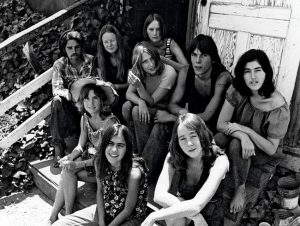
3) Manson Family (note: mainly female)
4) "Healter Skelter" written on LaBianca's fridge
5)Beatles White Album: Helter Skelter

   Image result for helter skelter manson
Image result for pig manson
Image result for manson family
Image result for helter skelter refrigerator
Image result for beatles white album helter skelter


Sources:
https://en.wikipedia.org/wiki/Manson_Family
https://en.wikipedia.org/wiki/Tate_murders
http://www.cnn.com/2009/CRIME/08/10/california.manson.murders/index.html
https://en.wikipedia.org/wiki/Manson_Family#Helter_Skelter
https://www.cnn.com/2013/09/30/us/manson-family-murders-fast-facts/index.html
https://www.biography.com/people/charles-manson-9397912
https://www.washingtonpost.com/news/retropolis/wp/2017/11/20/brutally-killed-by-charles-mansons-followers-sharon-tate-became-the-face-of-victims-rights/?utm_term=.1c800752fdcf

The Feminine Mystique

Betty Friedan
         Betty Friedan was a leading figure in the women's rights movement and is even credited for starting the second wave of feminism in America through her book, The Feminine Mystique. Friedan wrote about the period between World War II and 1960, when women married young, abandoned their ambitions, had large families that fueled the baby boom, moved to the suburbs and valued femininity above all else. Many women didn't even realize that they wanted or needed a change until Friedan's book came up and it became a frequent topic for discussion.


The Feminine Mystique.jpg           Friedan came up with the idea for writing the book in 1957, she had to conduct a survey of her former classmate. She found in her results that many of them were unhappy with their lives as housewives. This prompted her to begin research for The Feminine Mystique by conducting interviews with other suburban housewives. As well as having these interviews she researched media and advertising depictions of women. She originally intended to publish an article on the topic, not a book, but there were no magazines that would publish her article. Friedan's book had such a significant impact as it challenged the idea a the time that, "fulfilment as a woman had only one definition for American women after 1949—the housewife-mother." In the first 3 years of the book being printed over 3 million copies were sold

          Friedan later helped to organize NOW (The National Organization for Women), she helped to draft the founding statement of NOW. The statement called for "the true equality for all women". NOW demanded the removal of all barriers to "equal and economic advance". Friedan's influence can be seen in the founding statement; a main emphasis of the book is "women's need for identity and autonomy", and NOW's statement says "NOW is dedicated to the proposition that women first and foremost are human beings, who… must have the chance to develop their fullest human potential.


Soures:
https://en.wikipedia.org/wiki/The_Feminine_Mystique
http://www.nytimes.com/2013/02/19/books/betty-friedans-feminine-mystique-50-years-later.html

The King of Rock and Roll

Elvis Presley
Image result for Elvis Presley

Who Was Elvis Presley? Elvis Aaron Presley was a legendary American singer, musician, and actor. His career was at its height from 1950s to late 1970s. He is regarded as one of the most influential and significant cultural icon of the 20th century. Elvis is well known nick name is "The King" or more formally "The King of Rock & Roll ". He was given this nickname because he is said to have early popularized the genre of rock. His number one hit in 1956 included "Heatbreak Hotel". He continued on with many more hits such as Jailhouse Rock , Hound Dog, and Love Me Tender. 

He became the leading figure of rock and roll after a series of network television appearances and chart-topping records. His energized interpretations of songs and provocative performance style, made him enormously popular—and controversial.

Elvis was born in Tupelo, Tennessee and moved to Memphis at age 13. This influenced him and provided him with better opportunities to launch his music career. His music career began in Memphis in 1954 when he started to work with Sam Phillips, the owner of Sun Records.

He constantly worked tireless to create the sound he wanted and paint the way for many others after. He created a sound that was then described as a driven fusion between country and rhythm blues.
Elvis's music inspiration didn't come from one specific artist , instead many. He frequently attended the gospel signings' that lasted all night in Memphis at the Ellis Auditorium and this is said to be what sewed his seeds of his future stage act. Many African-American singers such as Buddy Holly and Chuck Berry influenced his sound. He took many styles such as blues and R&B and mixed it up. 

 Image result for elvis presley

In the 1950s , things had calmed down politically. No one was being provocative, especially celebrities. This included dancers and movie stars. Viewers and the rest of society were very strict on the wholesome image and felt the need for family friendly entertainment. In the spring of 1956, rock 'n' roll sensation Elvis Presley became a national phenomenon. His first single "Heartbreak Hotel," was number one on the charts, and plans were in the works for his movie debut. Everywhere he  performed, his sultry looks, swinging hips, and dynamic vocal style drove teenagers crazy.

His appearance on The Milton Berle Show on June 5, 1956, triggered one of the biggest first controversy's of his career. While Presley preformed his single "Hound Dog," of course he danced with all the pelvis-shaking intensity his fans scream for. Television critics across the country slam Elvis's performance for its "appalling lack of musicality," for its "vulgarity" and "animalism."

It wasn't just what Elvis was doing on stage he became iconic, everyone dreamed to be apart of what he had created. People thought that his vulgarer actions would inspire teenagers to become sex craved kids and this would ruin the ideal American home front and family beliefs. They though it would go as far as encouraging  juvenile delinquency. Elvis's popularity wasn't phased by the negative backlash. In the years to come his fame grew and grew, staring in movies, and preforming musically. His fan base grew as well. He was something new , something special , something unique and something that had never been seen or heard before. He became a sensation. Already, his mark on the 50s was at work. 

Elvis had a strong influence on youth culture. During the 1950s, teenagers had begun to think of themselves as being different from their parents’ generation. Because of the economic prosperity of the period, teens could easily enjoy things like purchasing records and listening to Elvis rather than helping their parents with money.  

With that money, they dressed themselves in fashions marketed to their age group, went to movies that featured stars of their generation, and listened to music that they liked. It wasn't surprising when Presley’s rock ’n’ roll music, his hairstyle, and his fashion sense became a part of this new culture for teenagers. Elvis became an influence on the youth during the 1950s and caused a burst of expression among young people.

Elvis was a musical revolution. He knew how to bring joy in everyday household and change the ideals of music and what it means to an individual. Elvis was so popular he paved the way and influenced upcoming rock and roll legends, aka the Beetles. If Elvis wouldn't have been so daring , different and unique, most likely the 1950s wouldn't have been what they were. Without his influence and popularity and his innovative ideas, music would never have "blossomed" into what it is now.

Image result for Thank you thank you very much  elvis

Sources:

- https://www.shmoop.com/1950s/elvis-presley.html

- http://www.dummies.com/education/history/american-history/elvis-presleys-musical-influence-on-america/ 

Sunday, February 11, 2018

The Doomsday Clock

Image result for doomsday clockOn January 25, 2018, the Bulletin of the Atomic Scientists announced that the Doomsday Clock had ticked, and the time on the clock was now 2 minutes to midnight.

It's possible you have heard the words "Doomsday Clock" before, but most are not sure exactly what it means or what the "minutes to midnight" part is all about.


It all started with the Bulletin of Atomic Scientists. In 1945, with the Cold War beginning to brew and the international coverage of the destruction in Hiroshima and Nagasaki due to atomic weapons, the scientists from the Manhattan Project who had helped to create nuclear weapons felt that they had to warn people about the dangerous effects of what they had made. They began to publish a newsletter about the atomic state of the world.

Image result for bulletin of atomic scientists 1947In 1947, the Bulletin switched formats from a newsletter to a magazine, and the scientists knew they wanted to have a visual on the front cover to demonstrate the threat of nuclear destruction.

Martyl Langsdorf, the wife of the Manhattan Project's Alexander Langsdorf, was recruited to design the cover of the magazine. Wanting to demonstrate the urgency she sensed from the Atomic Scientists, she decided to design clock hands ticking towards midnight, which was a symbol for the total nuclear destruction of the planet.


Martyl chose the time seven minutes til midnight arbitrarily, saying "it looked good to my eye", but both the scientists and the readers felt that it was a powerful image about the terrifying power of nuclear weapons.

Deciding that the image was a powerful visual, the Bulletin's first editor Eugene Rabinowitch originally reset the hands of the clock himself when he felt that there was a significant change in the threat of annihilation. During the 1950s, when the Cold War was at its strongest, he set the clock at 2 minutes to midnight to demonstrate the great possibility that the world was on the brink of nuclear war.
Image result for doomsday clock
Rabinowitch continued to move the hands of the clock until his death in 1973. After that, the Science and Security Board on the Bulletin decided to take over the job. They currently meet twice a year to discuss global affairs and release a statement about the stability of the Earth if the hands are moved.

While the clock only monitored nuclear activity at first, it now includes climate change, biosecurity, and cyber warfare in its criteria.

As of January 25, the Bulletin has determined annihilation is as imminent as it was during the height of the Cold War, which is terrifying to those who follow the movement of the clock. Others believe that due to the amount it has fluctuated over the past 70 years, the Doomsday Clock is not really that reliable or factual, and is instead entirely political in nature.

Whether or not the Clock is reliable, something we can be sure about is that it has measured the levels of international nuclear tension since 1947. And by examining the ticking of the hand, we can get a sense of how imminent the world believed destruction to be during every era of the Cold War.

https://thebulletin.org/timeline
https://thebulletin.org/background-and-mission-1945-2018
http://www.wired.co.uk/article/what-is-the-doomsday-clock
https://www.usatoday.com/story/tech/science/2018/01/25/doomsday-clock-ticks-closer-midnight/1064911001/
https://www.youtube.com/watch?v=jCnWPbn-ZKo

The Nashville workshops

The Nashville workshops were started by Rev. James Lawson, who moved south at the request of Martin Luther King. At Nashville, Lawson organized and trained a group of students on nonviolent protesting through a series of classes, seminars, and simulations. These students were chosen mainly because unlike adults, they had more time and freedom to commit to the protests.

The initial goal of the students was to desegregate local diners and restaurants, and to do this they held practices were students would act as the racists, while others would practice withstanding the punishment passively and without retaliation. Lawson taught the students to merely absorb the blows, and to respond in a "creatively loving fashion".
 Initially, the many students who participated and sat in at the diners weren't served. Instead of disturbing customers, they merely sat there and did their homework. On the third weekend of these sit-ins, the police showed up and over 80 students were either assaulted by other shoppers or arrested.

For the next two months, black students would continue their orderly protests. Day after day, they would go back to white businesses, where they would be gassed, assaulted, and have food poured on them. during this time period, Black citizens began boycotting segregated shops, and the tension reached a boiling point when a leading civil rights activist's house was bombed.

After the attack, the many protesting students demanded then Mayor Ben West to desegregate the city, which he eventually agreed to. Although the Nashville college students had won a great victory against segregation, they did not stop there. The continued protesting in front of movie theaters, and eventually many joined the now famous freedom riders to protest across America.

The Nashville workshops showed citizens all across America the merits of peaceful protesting and encouraged similar protests all over the country.


https://snccdigital.org/events/jim-lawson-conducts-nonviolent-workshops-in-nashville/

https://www.tennessean.com/story/news/local/2017/03/02/complete-coverage-civil-rights-movement-nashville/98648442/

http://www.crmvet.org/nars/lawsonj.htm#jl_nsm

Protection of Political Speech in Ohio


After the Smith Act and the Alien/Sedition Acts, there have been reasons for many people who are dissenters of politics. However, with the increase in liberal policy and violent outbreaks in the civil rights era, there were policies that were being created to protect people of hateful speech. The Ohio Criminal Syndicalism Act was designed to prohibit speech that would advocate "crime, sabotage, violence," etc. This bill hoped to protect the safety of the people of Ohio. What actually happened was something no one could have anticipated.

Brandenburg was a man who led a group of Ku Klux Klan, led a rally in Ohio in the late 60s and spoke at his rally, advocating to take vengeance against the government in Ohio. Following this, Brandenburg was arrested by the police by violating the Ohio Criminal Syndicalism Act. This case eventually reached the Supreme Court and there was a proposition that the Court was finally able to address: what did incitement of violence actually mean? If so, that would mean that Ohio violated the free speech rights of the KKK member.

The Supreme Court  UNANIMOUSLY ruled on June 9th, 1969 in favor of Brandenburg and determined that Brandenburg had his free speech rights violated by the Ohio Criminal Syndicalism Act. They saw this law as unconstitutional because they were unable to clearly define and distinguish between speech that actually was directly inciting violence and teaching such ideologies that could lead to violence. If the law couldn't actually do this "strict scrutiny" test effectively, then the law was unconstitutional and violated the rights of Ohio citizens by the First and Fourteenth Amendments.

At a time when it was unpopular for liberals to nationally support groups such as the KKK, the Supreme Court in one of its most liberal constructions, didn't shy away from protecting the political speech rights of all Americans. By choosing to set a precedent to protect any political speech that didn't directly incite violence, it opened the door for legal protests that took place in places like Charlottesville. Although these protests have resulted in violence, this protest of not directly being done to incite violence has allowed protests like these to exist and continue to thrive. Even in California, there have been a few protests in the past few months by the KKK, but it is crucial to remember that those rights that are protected for the KKK to protest is what allowed protest for Black Lives Matter and the Women's March to exist.

Sources:
https://www.oyez.org/cases/1968/492
https://www.casebriefs.com/blog/law/constitutional-law/constitutional-law-keyed-to-stone/freedom-of-expression/brandenburg-v-ohio-2/
https://globalfreedomofexpression.columbia.edu/cases/brandenburg-v-ohio/
http://www.latimes.com/local/lanow/la-me-ln-far-right-california-20170818-story.html

Saturday, February 10, 2018

Ivy Meeropol: An Unusual Family History

When Ivy Meeropol was just five years old, her father, Michael Meeropol, told her what had happened to her grandparents, Julius and Ethel Rosenberg. Her grandparents’ execution during the Cold War, the only peacetime execution for espionage in the United States, is a very famous example from the era of McCarthyism which illustrated the effects of the widespread paranoia throughout the country. Although she never had the chance to meet her grandparents, the story of what happened to them stuck with Ivy Meeropol, who would become a filmmaker and share their story.


Ivy Meeropol dcefforgwpcontentuploads201506IvyMeeropol


In 2004, Ivy Meeropol released Heir to an Execution. The film follows the story of Julius and Ethel Rosenberg, as Meeropol strives to delve deeper into what happened to her grandparents, beyond the most well-known facts. Meeropol knew that she had to face all of the myths surrounding her grandparents’ execution directly, in order to reach the truths and fulfill her goal of learning about what Julius and Ethel Rosenberg were really like as people.


Image result for ivy meeropol michael

Michael Meeropol, the eldest son of Julius and Ethel Rosenberg (Michael and his brother Robert took the last name of the couple who adopted them after their parents’ execution), who was only ten years old at the time of his parents’ death, also played a key role in the film. Although Ivy was curious about the details of what happened to her grandparents and what the situation was really like for her father and uncle, she had not asked many of her questions to her father until it was actually time to film them, to ultimately permit the public to know the answers to those questions as well. Michael stated that when it first became clear that Ivy wanted to create a film or book to share the story of Julius and Ethel Rosenberg, years before she actually would do so, he had discouraged her. However, she continued to want to make a film about the matter and felt that it was what she needed to do, so he later approved and agreed to answer her questions.


“The question of guilt and innocence was never something that I felt was my role to deal with,” stated Ivy Meeropol, clarifying her intentions in making the film. She wanted to inform people of the story of her grandparents, and in order to do so as well as she could, she even reached out to some estranged family members. However, to Ivy’s initial surprise, many of them refused to be part of her film or even to have their voices heard for it. They would tell her that it was too painful, even five decades later. This really showed the extent of the sensitivity regarding the events surrounding Julius and Ethel Rosenberg and also made clear to Ivy just how many people were affected by what happened to them at the time, so strongly that it would continue to prevent them from speaking about certain topics for the rest of their lives.


In 2016, Michael and Robert Meeropol went to the White House with a letter for President Obama. Due to the “injustice done to [their] mother,” they asked for him to issue a statement to exonerate Ethel Rosenberg. The brothers asserted that perjured testimony and judicial misconduct were the reasons for their mother’s execution, striving to at least clear her name. Robert Meeropol stated, “The FBI files show that my mother was only arrested to use as a lever against her husband,” providing evidence for his and his brother’s recent request. Overall, the making of Ivy Meeropol’s film again brought up the controversy regarding the executions of Julius and Ethel Rosenberg for espionage during the Cold War and has shown that this extremely significant event continues to directly impact the lives of Americans today.